
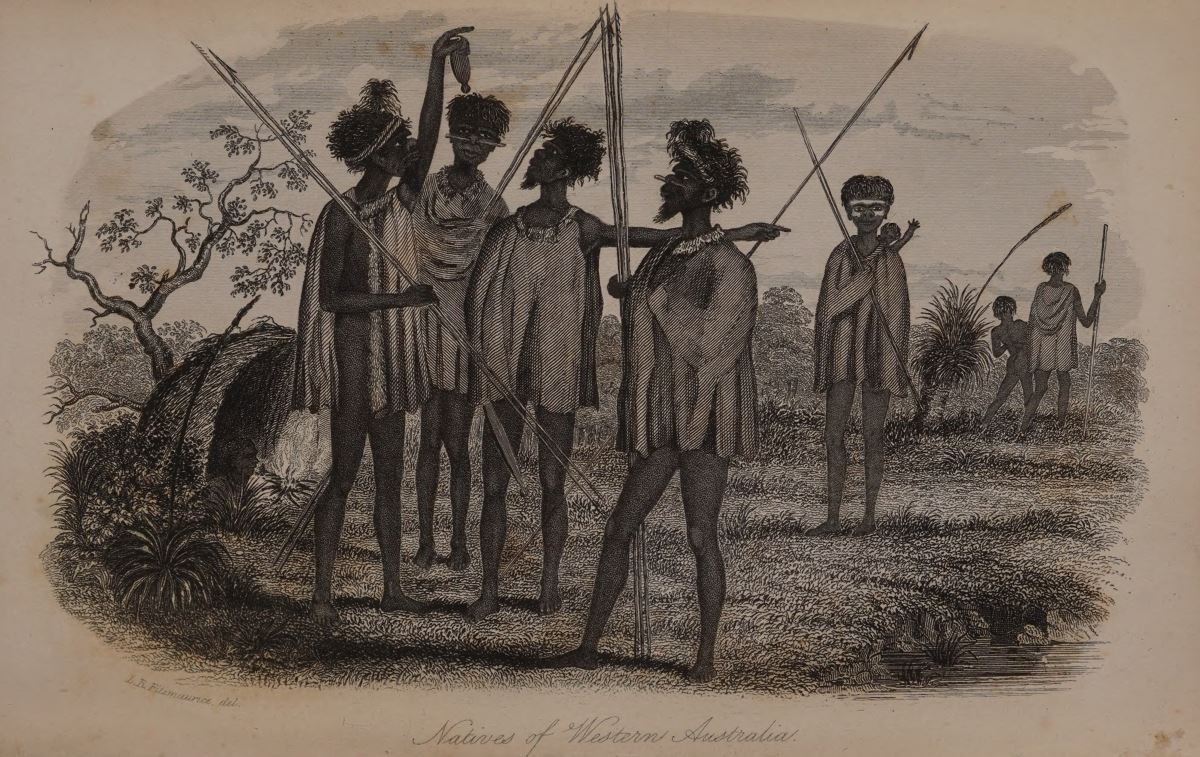
The encounter between European settlers and the Aboriginal people of Australia has long been framed this way, as a meeting between “advanced” and “primitive” worlds. Yet, the detailed observations of these early settlers—though frequently biased—contain a truth that undermines this framework. Within their notes on language, art, and social organization lies a record of resonance. The Aboriginal cultures of Australia exhibited remarkable similarities to societies across the globe, suggesting a shared human ingenuity and hinting at ancient connections that have yet to be fully understood.
Language and Linguistic Links
Richard Sadleir observed in his work that “the grammatical structure of all Australian aboriginal dialects is the same.” But more remarkably, he noted that “A few words show a connection with the Aryan rather than the Turannian race and are in fact, allied, both in sound and meaning, to words used by nations deriving their speech from the Sanscrit.”
This potential link to Indo-European languages was not seen as entirely homegrown. Sadleir suggested that “Possibly this may have been caused by the intercourse with Malays who from time to time visited the northern coast.”
The linguistic similarities extended beyond Asia. Sadleir’s work includes a direct report from L. E. Threlkeld, who stated that the 1839 annual report made “allusion to the similarity of the aboriginal language with the Cherokee Indian.” Threlkeld specified that the “Cherokee habitual form of the verb agree[ed] with the modification in the Australian Grammar,” and that a comparison had been made of dialects from Lake Macquarie, Manila River, Swan River, and King George’s Sound.
Furthermore, as noted in Kamilaroi and Kurnai by Lorimer Fison and A. W. Howitt, the use of gesture language by Aboriginal people was significant. The authors argued that this form of communication, which was also advanced by the North American Indians, should not be mistaken for a sign of simplicity.
They stated that gesture language “fails to prove poverty of language,” pointing out that the North American Indians possessed languages that were not only sufficient for all their needs but were also “copious enough to furnish materials for abundant oratory.” Far from being evidence of mental inferiority, Fison and Howitt suggested that gesture language may yet be discovered to be “a proof of a quite remarkable intelligence.”
Artistic Expression and Monuments
The artistic works found across the continent provided early hints of a shared human heritage. Explorers documented discoveries of drawings “of porpoises, turtles, fish, &c., and a human head, done in charcoal or burnt stick and something like white paint, upon the face of the rock.”
One particular point of fascination was the “painted hands” seen in caves, a “singular device, which is also met with amongst the North American Indians.” This simple yet powerful symbol creates a tangible link across cultures. Other works displayed significant skill, such as “the profile of a man cut in solid stone, of a character more European than Native, executed in a style beyond what any savage would be thought capable of.”
The origin of some coastal art was a subject of debate, with some contemporary observers suggesting they “may be the work probably of some persons who had visited the coast, and not of the aboriginals themselves, as the Malays frequently visited the coast.”
Perhaps most striking were the large-scale stone constructions. The “stone circles at Mount Elephant, Victoria” were noted for their resemblance to the famous “stone monuments at Stonehenge in England.” This evidence challenged prevailing notions, suggesting a capacity for the coordinated, communal effort required to build such enduring monuments.
Systems of Kinship and Relationship
Richard Sadleir documented that their “relationships are complex.” He identified that they follow “the Tamilian system which obtains amongst North-American Indians, and the Telugu and Tamil tribes in the East Indies.”
This system defines relationships in a specific way:
- A man considers his brother’s children as his own sons and daughters, but his sister’s children are only nephews and nieces.
- Conversely, a woman counts her sister’s children as her own, but her brother’s children as nephews and nieces.
- This means children view their father’s brother as a father, but his sister merely as an aunt; and their mother’s sister as a mother, but her brother only as an uncle.
From this, Sadleir deduced that “it seems possible that some Aborigines came from Southern India–were driven southward by the Malays.”
This analysis was explored in greater depth by Lorimer Fison and A. W. Howitt in Kamilaroi and Kurnai. Their study of the Kurnai people found evidence in their terms of relationship that were “strictly Malayan in theory.” Their analysis suggested these systems “strongly suggest a more archaic form of family” and showed that the complex terms of kinship “necessarily arise from class divisions”—a system also governing the social laws of American Indians and numerous Asiatic and African tribes.
Intelligence and Capability
Richard Sadleir noted that while some considered their skill in war and subtlety as diplomats “quite equal to the North American Indian,” he personally found this comparison “rather exaggerated.”
However, Gideon Lang, as quoted in Sadleir’s work, held a “very different opinion.” He argued that no one seeing them “merely as idle wandering vagabonds among the white men” could judge their capabilities in a natural state. Lang pointed to extraordinary works like the fish weir on the Upper Darling, called Breewarner. He described it as, “both for conception and execution, one of the most extraordinary works recorded of any savage tribe.” This labyrinth of stone walls, built to withstand floods and efficiently catch fish, demonstrated the Aborigine’s capacity for “great combined labour” and large-scale construction.
Lang also witnessed their remarkable problem-solving skills firsthand. He recalled when his party was puzzled by a muddy waterhole, their two Aboriginal guides solved the dilemma by sinking a hole in the mud and using a reed to siphon clean water. “And so I have always found the natives ready with some peculiar plan for whatever emergency might arise,” he noted.
Their hunting prowess was exceptional. Lang observed that they would “walk up to a kangaroo or an emu, in an open plain, in broad daylight, and spear it, though the animal may be watching them suspiciously all the time.” Their stealth was such that they could imitate logs—like the American Indians—so perfectly they once deceived Lang himself while he was on high alert during a conflict.
Furthermore, they possessed significant knowledge of astronomy. One native guide accompanying Lang “divided the heavens into constellations almost identical with those of our own astronomers, and named them after various animals,” even correctly pointing out the position of a constellation below the horizon.
Their physical capabilities were also undeniable. Sadleir recounted an incredible story of four divers who retrieved a case of claret from eight fathoms of water, and Queen Onion diving into the deep water off Garden Island to retrieve a lost penknife from the seabed.
Physical Characteristics and Origins
Richard Sadleir noted a variety of appearances, stating, “Some have frizzled hair like the Papuans, and others have hair over their shoulders like Maccabars.” In colour, he observed that “Some are as black as negroes; others copper-coloured like Malays.”
He also recorded that “The formation of their skull is sometimes low but in many instances large and equal to the average of Europeans.”
These observations led to theories about their potential connections to other groups. Sadleir suggested that “Some may be descended from the arabs who spread themselves beyond the Indian Archipegalo. From the mixture of Arab words, and the rites of circumcision in some tribes, and from the extensive spread of the Arab; there may be reason to suppose they have a large infusion of that blood.”
He also noted the strong resemblance to the people of the adjoining islands, who “go naked, have no fixed habitation, use bone and stone implements, have no knowledge of metals or pottery, and in stature, colour, and appearance are similar but they resemble more the Tasmanians, who are of purer blood.”
Spiritual Beliefs
According to Richard Sadleir, R.N., J.P. in The Aborigines of Australia, they are “a people free from idolatry.” This was a significant trait they shared with other indigenous cultures, as “The North-American Indians are not idolatrous, but have a belief in a Superior Being.”
Furthermore, observations of certain sites led to speculation about their practices. Sadleir suggested that caves containing offerings, like that of a kangaroo, and featuring a seat might be “places of worship, like the caves in India, is not improbable, especially… for some presiding person, priest, or doctor.”
Conclusion
The evidence within these historical accounts doesn’t show simple savagery, but a people with a deep and complex culture, whose arts, languages, social structures, and capabilities resonate with tribes and nations across the globe. The similarities are too numerous to be mere coincidence, suggesting a rich, ancient, and interconnected human story.