
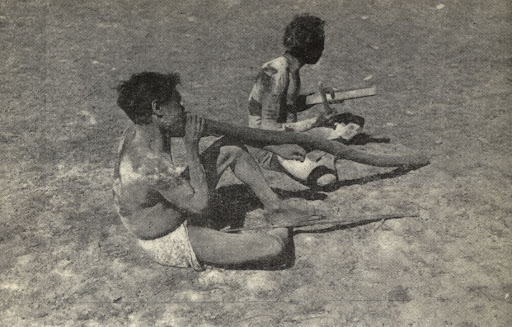
Theories on the Didgeridoo’s Origins The question of whether the didgeridoo is a “later comer” to the Australian musical scene is raised directly within the historical texts, pointing to a fascinating debate about its distribution and antiquity. The evidence suggests that while the instrument was widespread in Arnhem Land, its presence elsewhere was more sporadic. […]
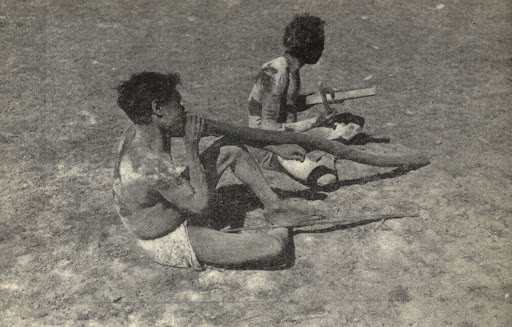
Didgeridoo, Nature’s Ready-Made Instrument The didgeridoo is an example of ingenuity, crafted directly from the materials provided by the Australian landscape. Unlike instruments that require complex carving, its primary component is a pre-existing hollow tube, perfected by nature itself. As described by Herbert Basedow in The Australian Aboriginal, the instrument is typically made from […]
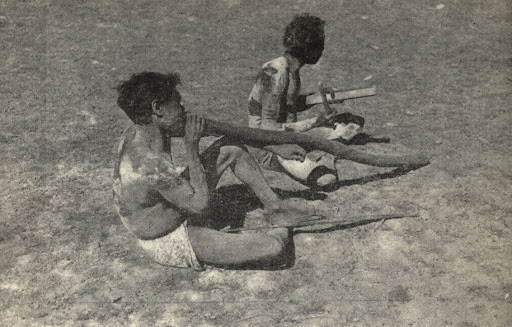
Indicate the distribution of the Didgeridoo. The total number of tribes that used didgeridoo in 1700. When it was used (ceremonies). In the heavy, sweltering heat of the Northern Territory’s wet season, the air hangs still. On the long verandah of a cattle station, the only signs of life are the debris of a slow […]
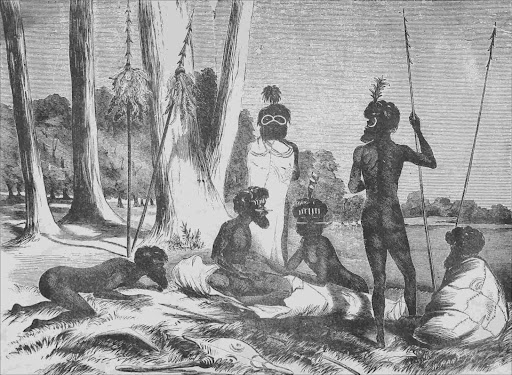
Early European accounts provide insights into Aboriginal Australian social organization, revealing complex systems of land tenure, leadership, and group structure. A crucial starting point is the definition of “tribe.” As Lorimer Fison and A.W. Howitt cautioned, this term is deeply misleading. It could describe an entire distinct community, like the Larakia, or a smaller division […]
Based on the study, here are the ways in which the Didgeridoo was used by the Aborigines of Australia:
The “didgeridoo” is made of wood. This wood can be either bamboo (all the sources agree on this), woolly-butt eucalyptus, or the green stem of a native hibiscus bush (according to Herbert Basedow). Spencer, in his recordings of Australian Aboriginal singing also mentioned trumpets can be “made out of a hollow branch of gum trees, ironwood etc.”
A typical didgeridoo size varies from 2 to 9 feet long. Roderick Flanagan describes it as having “about three feet in length” and Spencer said “it measured 7-9 feet in length.” Spencer also reported a trumpet which was “five feet in length” and had a diameter at larger end of 2.5 inches and 2 inches at the mouth while Basedow asserts that it should be “four to five feet long” which aligns with the trumpet observed in Native Tribe of the Northern Territory of Australia.
The mouthpiece was often refined for comfort and to create a proper seal. Spencer observed that “as a general rule, the mouth end is coated with wax so that the lips can fit on tightly,” a detail also mentioned in the Native Tribes of Central Australia that the end is “covered with a circle of resin so as to make the margins smoother.”
The external surface was frequently decorated, transforming it into a personal and cultural artifact. Spencer in the Native Tribes of Central Australia described two such decorated instruments in his possession: one was ornamented with “alternate circles of yellow ochre and white kaolin,” while the other featured “two rings of white kaolin” connected by longitudinal lines.”
Herbert Basedow called it a “bamboo trumpet”, “drone-pipe” or “didjeridoo.” Sir Baldwin Spencer in his analysis of recordings of the Australian Aboriginal singing suggested the more specific term “conch,” drawing a comparison to shell trumpets despite it being made of wood or bamboo, noting it was “commonly called a trumpet by the whites, but really a kind of conch, made out of a hollow bough.”
Spencer, in his analysis of recordings, referred to the work of Roth, who documented the term “yiki-yiki” for a long wooden trumpet used in areas of the Cape York Peninsula. In his own documentation of Native Tribes of the Northern Territory of Australia, Spencer also listed the sacred names “jiboulu” for the everyday trumpet and its ritual counterpart, “Purakakka.”
From Central Australia, Spencer and Gillen described the “ilpirra” (or “ulpirra”), a shorter, rudimentary tube used in love-magic ceremonies, which they distinguished as a “rudimentary trumpet” that was sung through to intensify the voice rather than played with vibrating lips.
The name “didgeridoo” was first used in a 1908 newspaper account “Retribution,” where it was written as “did-gery-do,” phonetically capturing the rhythmic sound heard on a Northern Territory cattle run. The term simply did not exist in print until the early 20th century.
"*" indicates required fields