
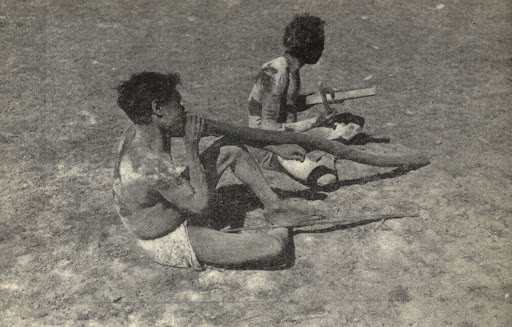
Didgeridoo, Nature’s Ready-Made Instrument
The didgeridoo is an example of ingenuity, crafted directly from the materials provided by the Australian landscape. Unlike instruments that require complex carving, its primary component is a pre-existing hollow tube, perfected by nature itself.
As described by Herbert Basedow in The Australian Aboriginal, the instrument is typically made from “a piece of bamboo, of the stout, tropical variety, from four to five feet long.” Basedow also notes that the internal septa of the bamboo are removed by burning them out “with a fire-stick.” Where bamboo was not available, Aboriginal craftsmen used “a long hollow limb of the woolly-butt eucalyptus” (Basedow).
The prevalence of hollow branches in the north made this process straightforward, as Baldwin Spencer observed in Native Tribes of the Northern Territory of Australia: “It is very rare, in any of the northern parts of the Territory to find any branches which are not hollow, so that the native can easily secure one that is suitable for a trumpet.”
The mouthpiece was often refined for comfort and to create a proper seal. Spencer observed that “as a general rule, the mouth end is coated with wax so that the lips can fit on tightly,” a detail also mentioned by Basedow, who wrote that the end is “covered with a circle of resin so as to make the margins smoother.”
The external surface was frequently decorated, transforming the didgeridoo into a personal and cultural artifact. Spencer described two such decorated instruments in his possession: one was ornamented with “alternate circles of yellow ochre and white kaolin,” while the other featured “two rings of white kaolin” connected by longitudinal lines.
For more temporary use, Basedow notes that a quick substitute for the didgeridoo could be made from a “green stem of a native hybiscus bush,” with the bark removed “in toto in the form of a pipe,” demonstrating the instrument’s deep connection to the immediate environment and the resourcefulness of its makers.
The Playing Technique of the Didgeridoo: A Unique Circular Technique
The playing technique of the didgeridoo, which allows for a continuous, uninterrupted sound, is one of its most defining features and was a point of fascination for early observers.
The method is highly specific. As Herbert Basedow described, “When using the ‘trumpet,’ the operator blows into the end having the smaller diameter, with a vibratory motion of the lips, and at the same time sputters into the tube indistinct words.”
What seemed most novel was the player’s ability to maintain this sound indefinitely. Basedow precisely noted the physiological feat involved: “The native, while he is blowing into the pipe, continues to breathe normally through his nostrils, after the same style as one does when using a blow-pipe in the laboratory.” This description captures the essence of circular breathing, where air is expelled from the mouth while simultaneously being inhaled through the nose.
This technique sets the instrument apart. As Roderick J. Flanagan had earlier observed, it was considered “a novelty in the musical world,” not just for being played with the nasal breath, but for the resulting “droning noise” that could be produced continuously.
The Didgeridoo’s “Biddle-an-bum” in Ritual
Beyond the casual music of the station camp, the didgeridoo—or as it was often historically called, the “trumpet” or “conch”—played an improtant role in Aboriginal ceremony. The instrument’s sound was the foundational pulse of ritual, a voice connecting the present moment to the ancestral past
Early anthropologists like Sir Baldwin Spencer documented this crucial function.
In the initiation ceremonies of the Northern Territory, the sound of the trumpets was a constant, vital presence. During one such ritual, Spencer noted, “Meanwhile sticks are struck together and the bamboo trumpets sound, making a noise which sounds like a constant repetition of biddle-an-bum, biddle-an-bum.” This description captures the rhythmic, booming quality that formed a powerful auditory backdrop to the sacred proceedings.
The instrument was so central to these rituals that it was often integrated into the very mythology being enacted. In a ceremony re-enacting the actions of the ancestral being Ngabadaua, Spencer describes how the figure “seated himself, facing the Jumungail, on a hollow log called Purakakka. This is supposed to represent a trumpet, and is the sacred name for the ordinary one called Jiboulu.” Here, the physical instrument and its mythic counterpart become one, blurring the line between object and symbol.
This droning sound served multiple purposes: it created an atmosphere of solemnity, signaled key moments in the ritual, and provided a rhythmic structure for the performers. Its deep, resonant boom, with a “long, strong emphasis on the ‘bum,'” was the heartbeat of the ceremony, a sound believed to be as ancient as the stories being told